

































Macro counting (IIFYM): what it is

This article is general information, not medical advice. Talk to your doctor or a registered dietitian before changing your diet, especially if you have a health condition, take medication, or are pregnant or breastfeeding. Disclosure: Kalomo AI makes a calorie-tracking app, which we mention at the end of this article.
The short answer
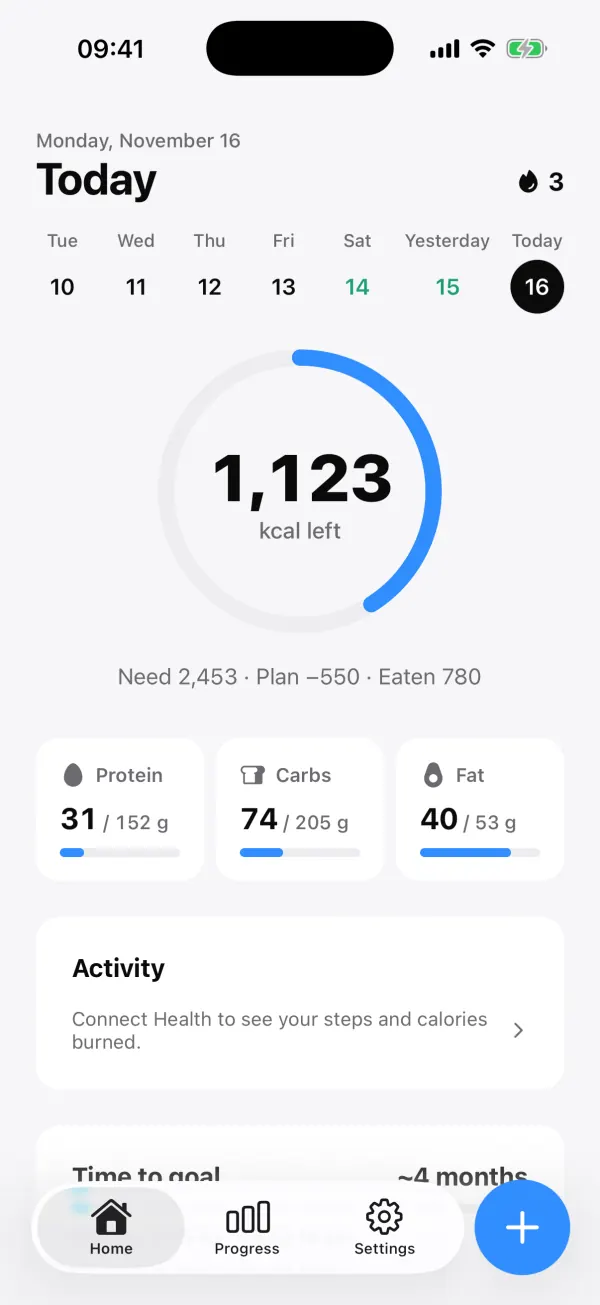
Macro counting, often called IIFYM (“If It Fits Your Macros”), means tracking grams of protein, carbohydrate and fat instead of only calories. Because those three macros add up to your calories, it is calorie counting with more detail. Research shows total calories drive weight loss more than the exact macro split, so the main benefits are structure and enough protein. The cost is time, and for some people an unhealthy focus on numbers.
What macro counting is
“Macros” is short for macronutrients, the three nutrients that supply most of the energy in food: protein, carbohydrate and fat. With macro counting, you set a daily gram target for each one and log what you eat to hit those targets.
The IIFYM label comes from fitness culture. The idea is that no food is off-limits as long as it fits your daily numbers. That flexibility is the appeal. It is also the weak spot, because a day can “fit” on paper and still be low in fiber, vegetables and micronutrients.
How macros turn into calories
Food labels and tracking apps use average energy values known as Atwater factors: protein and carbohydrate provide about 4 calories per gram, and fat about 9 (USDA Agricultural Research Service). So if you know your grams, you know your calories:
calories ≈ (protein g × 4) + (carbs g × 4) + (fat g × 9)
These are averages, not exact values for every food. USDA researchers found that a 1-ounce serving of almonds labeled at 168 calories actually provided about 129, because some of the fat, protein and carbohydrate in whole nuts isn't absorbed (USDA ARS). Treat your daily totals as good estimates, not lab measurements.
How to set your macros
Macro targets start from a calorie target, so work that out first. The calorie guide explains how. Then split those calories using ranges that have solid evidence behind them.
- Know the healthy ranges. For adults, the National Academies' Acceptable Macronutrient Distribution Ranges are 45–65% of calories from carbohydrate, 20–35% from fat and 10–35% from protein (National Academies). Most sensible splits fall inside these ranges.
- Set protein first. The recommended minimum for adults is 0.8 g of protein per kg of body weight per day (Harvard T.H. Chan School of Public Health). That is a floor, not a ceiling. Going higher is fine as long as you stay within the 10–35% range.
- Divide the rest between carbs and fat based on what you like to eat and can stick with.
- Convert to grams. Example: 2,000 calories at 30% protein, 40% carbs and 30% fat is 600 ÷ 4 = 150 g protein, 800 ÷ 4 = 200 g carbs, and 600 ÷ 9 ≈ 67 g fat.
- Log for a few weeks, then reassess. Watch your weight trend and how you feel, and adjust calories before you fiddle with the split.
An example day
Ranges are easier to grasp with real food. The day below uses dishes from our database at their standard portions. Together they come to roughly 1,355 kcal, with about 119 g protein, 115 g carbohydrate and 45 g fat, or about 35% protein, 34% carbs and 30% fat.
Logging shows two things at a glance. Protein is already well covered. Carbs sit below the 45% minimum of the adult range, so the remaining calories are best spent on fruit, whole grains, beans or milk rather than more meat.
Pros and cons
- Pro: structure. Writing food down is linked with weight loss. A systematic review of 22 studies found a consistent association between self-monitoring and weight loss, though it rated the evidence as weak because of study limitations (Burke et al., 2011).
- Pro: protein awareness. Tracking makes it obvious when a day is mostly refined carbs and very little protein.
- Pro: flexibility. No food is banned outright, which some people find easier to sustain than rigid rules.
- Con: it takes time. Weighing and logging every meal is a real commitment, especially with home-cooked mixed dishes.
- Con: numbers aren't quality. Macros say nothing about fiber, vitamins, salt or saturated fat. Harvard's nutrition experts stress that the protein “package” (what comes with the protein) matters more than the gram count alone (Harvard T.H. Chan).
- Con: estimates have error. Labels use averages, and portion guesses add more uncertainty.
Who should be careful or skip it
Close tracking doesn't suit everyone. In a study of 493 college students, people who used calorie-tracking apps reported more eating concerns and dietary restraint. The authors called the findings preliminary, and the study can't show cause and effect (Simpson & Mazzeo, 2017). Still, it is a reason for caution.
- A history of an eating disorder, or a sense that tracking makes you anxious or rigid around food: skip detailed macro counting and talk to a professional.
- Pregnancy or breastfeeding: nutrient needs change, so set targets with your doctor or a registered dietitian.
- Kidney disease: protein targets may need to be set by your care team, so don't push protein high on your own.
- Diabetes on medication: big shifts in carbohydrate can affect blood sugar and medication needs, so check with your care team first.
- Children and teens: their ranges differ from adults', and number-focused dieting isn't appropriate for them.
Does the macro split matter for weight loss?
Less than the internet suggests. In the POUNDS Lost trial, 811 adults with overweight were randomly assigned to four reduced-calorie diets with different fat, protein and carbohydrate targets. After two years, weight loss was similar no matter which macronutrients were emphasized (Sacks et al., NEJM, 2009).
The DIETFITS trial found the same pattern. Among 609 adults, a healthy low-fat diet and a healthy low-carb diet produced 12-month weight losses of 5.3 kg and 6.0 kg. The difference was not significant, and neither genotype nor insulin secretion predicted who did better (Gardner et al., JAMA, 2018).
In practice: get your calories right, keep protein adequate and stay within the healthy ranges. Then pick the split you can live with. Food quality still matters for health even when it doesn't change the scale much.
What the evidence says, in short
Macro counting is a detailed form of calorie tracking. Self-monitoring is consistently linked with weight loss, but the studies are weak. Large trials show that the exact macro ratio matters little for weight loss when calories are controlled. The healthy adult ranges (45–65% carbs, 20–35% fat, 10–35% protein) give plenty of room. The main risks are the time it takes and, for some people, a harmful fixation on numbers. If tracking every gram feels like too much, simpler approaches like portion control can work too.
A sample day
An example of how macros add up across a day, using standard portions from our dish database. It shows the arithmetic and is not a calorie target. Fill the rest of your day according to your own needs.
- BreakfastOatmeal1 bowl (240 g): about 154 kcal, 5 g protein, 27 g carbs, 3 g fat. Add fruit or milk to raise carbs and protein.154 kcal1 bowl
- LunchBurrito bowl1 bowl (450 g): about 652 kcal with 58 g protein, the biggest protein contributor of the day.653 kcal1 bowl
- DinnerGrilled chicken breast1 breast (170 g): about 299 kcal, 50 g protein, no carbs, 9 g fat.299 kcal1 breast
- Dinner sideBaked potato1 potato (200 g): about 250 kcal and 40 g carbs to balance a protein-heavy plate.250 kcal1 potato
Frequently asked questions
What does IIFYM stand for?
“If It Fits Your Macros.” It means eating any foods you like as long as your daily protein, carbohydrate and fat grams stay within your targets.
Is counting macros better than counting calories for weight loss?
Not for weight loss itself. Trials comparing different macro splits at reduced calories found similar weight loss (Sacks et al., 2009; Gardner et al., 2018). Macro counting adds detail, mainly about protein, which some people find useful.
What is a good macro ratio to start with?
Any split within the adult ranges of 45–65% carbs, 20–35% fat and 10–35% protein is a reasonable start (National Academies). Set protein so you get at least 0.8 g per kg of body weight, then divide the rest by preference.
How many calories are in a gram of protein, carbs and fat?
On average, about 4 calories per gram for protein and carbohydrate and 9 for fat (USDA ARS). Actual absorbed energy can be a bit lower for some foods, such as whole nuts.
Can macro counting be unhealthy?
It can be for some people. Calorie-tracking app use has been linked with more eating concerns in college students, though the evidence is preliminary (Simpson & Mazzeo, 2017). If tracking makes you anxious or you have had an eating disorder, choose a different approach and get support.
Sources
- Rethinking the Acceptable Macronutrient Distribution Range for the 21st Century: A Letter Report — National Academies of Sciences, Engineering, and Medicine
- Protein — Harvard T.H. Chan School of Public Health, The Nutrition Source
- An Improved Method To Estimate Calories — USDA Agricultural Research Service, AgResearch Magazine
- Comparison of weight-loss diets with different compositions of fat, protein, and carbohydrates — New England Journal of Medicine (via PubMed, NCBI)
- Effect of Low-Fat vs Low-Carbohydrate Diet on 12-Month Weight Loss in Overweight Adults (DIETFITS) — JAMA (via PubMed, NCBI)
- Self-monitoring in weight loss: a systematic review of the literature — Journal of the American Dietetic Association (via PubMed, NCBI)
- Calorie counting and fitness tracking technology: Associations with eating disorder symptomatology — Eating Behaviors (via PubMed, NCBI)
Related articles
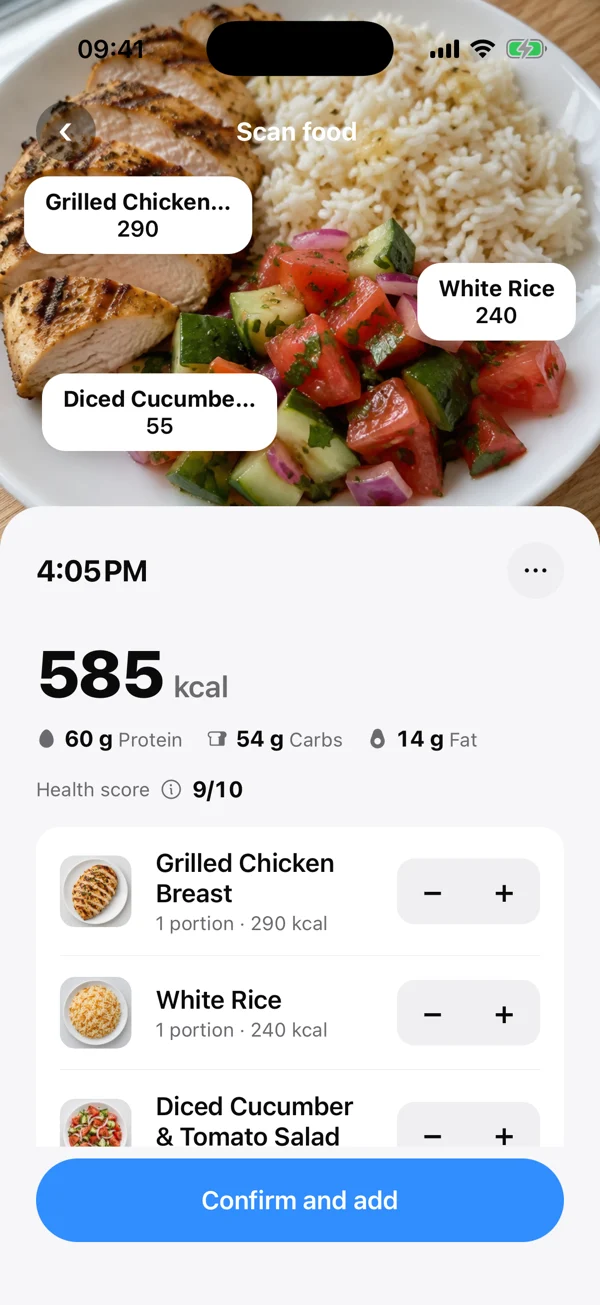
Track your plan with Kalomo AI
Snap a photo of your plate and get calories and macros in your log in seconds.