

































How to count calories
This article is general information, not medical advice. Talk to your doctor or a registered dietitian before changing your diet, especially if you have a health condition, take medication, or are pregnant or breastfeeding. Disclosure: Kalomo AI makes a calorie-tracking app, which we mention at the end of this article.
The short answer
To count calories, write down everything you eat and drink, estimate the amount (weighing helps), and look up its energy value on the label or in a food database. Research consistently links this kind of self-monitoring with weight loss, but people tend to underestimate what they eat, so logging everything honestly matters more than getting each number exact.
What counting calories actually measures
A calorie, as used on food labels, is a unit of the energy in food and drink. In the US you'll see it simply as “Calories”; in Europe and on many imported products it appears as kcal next to kilojoules (kJ), under the heading “energy,” as the NHS explains.
The principle behind counting is energy balance: eating more calories than you use over time leads to weight gain, and eating fewer leads to weight loss. Counting doesn't change that principle; it just makes your intake visible, so you can compare it with what your body uses.
How to do it, step by step
- Pick one place to log. An app, a notebook, a notes file. The tool matters less than using it every day.
- Log as you go. Writing things down right after eating is far more accurate than reconstructing the day at bedtime.
- Read the label the right way. On a US Nutrition Facts label, calories are listed per serving, and the FDA points out that the serving size is a standardized amount, not a recommendation. Check servings per container: if a package holds 4 servings of 280 calories and you eat it all, that's 1,120 calories.
- Weigh, at least at first. A cheap kitchen scale for a week or two trains your eye. It matters most for calorie-dense foods like oil and nut butter, where a few extra grams change the total a lot.
- Count drinks and extras. Lattes, juice, soda, alcohol, dressings, the oil in the pan and the bites while cooking all have calories.
- For home-cooked and restaurant dishes, use a typical-portion value. Pick an entry that matches the dish and portion, and adjust if yours is clearly bigger or richer. Our calorie guide lists common American dishes per portion and per 100 g, built from USDA FoodData Central data.
- Look at the weekly trend. Daily totals bounce around; a 7-day average tells you much more.
Calories and macros
Calories tell you how much energy; macronutrients (protein, carbohydrate and fat) tell you where it comes from. Most labels and databases give both, so once you're logging calories, macros come almost for free.
Two days with the same calorie total can look very different in protein, fiber and sugar, so it's worth glancing at more than the total once logging becomes a habit. If you want to go further, see the related article on macro counting.
Pros and cons
Pros: it's flexible (no food is off-limits), it works with any cuisine, it shows you which foods and drinks quietly add the most, and it gives you real numbers to work with instead of guesses.
Cons: it takes time, estimates are never exact, eating out is hard to log, and for some people the constant focus on numbers becomes stressful or obsessive. Many people use it intensively for a few weeks to learn their portions and then switch to lighter tracking.
What the evidence says
A systematic review of self-monitoring in behavioral weight-loss programs found 22 studies, 15 of them on tracking diet, and a consistent link between self-monitoring and weight loss. The authors rated the strength of evidence as weak, though, because of methodological limits: samples were mostly white women and adherence was self-reported.
The other side is accuracy. In a well-known 1992 study, a small group of people who said they could not lose weight on under 1,200 kcal a day were measured carefully: they had underreported their food intake by an average of 47% and overreported their physical activity by 51%. Their metabolism was normal. This isn't a moral failing. Food is simply hard to estimate without measuring it, which is a good reason to weigh and log honestly.
The NHS suggests aiming to lose about 0.5–1 kg (1–2 pounds) a week. If your logs say you're in a deficit but the weekly average doesn't move for several weeks, your logging is usually the first thing to check.
Who should not count calories
Calorie counting isn't right for everyone. A study of 493 college students found that those who used calorie-tracking apps showed higher levels of eating concern and dietary restraint, and the authors cautioned that for some people these tools may do more harm than good. If you have a history of an eating disorder, or you notice that tracking makes you anxious or rigid about food, skip it and talk to a doctor or dietitian.
Children and teens shouldn't count calories for weight loss without medical guidance, and if you are pregnant, breastfeeding, or managing diabetes or kidney disease with medication or a set meal plan, work out any targets with your care team rather than on your own.
A sample day
Here is what a logged day can look like, using typical portions from our guide. It shows the method, not a target: your own needs depend on your size, age and activity.
- BreakfastOatmeal1 bowl (240 g) is about 154 kcal; toppings like nut butter or sugar are logged separately.154 kcal1 bowl
- CoffeeLatteA 16 fl oz latte is about 202 kcal, a good reminder that drinks count.202 kcal1 large cup (16 fl oz)
- LunchTurkey sandwich1 sandwich (200 g) is about 428 kcal with roughly 28 g of protein.428 kcal1 sandwich
- DinnerGrilled chicken breast1 breast (170 g) is about 299 kcal and 50 g of protein; weigh it cooked if you can.299 kcal1 breast
- SideBaked potato1 potato (200 g) is about 250 kcal; butter and sour cream add up fast.250 kcal1 potato
Frequently asked questions
Do I need to weigh my food to count calories?
Not forever, but weighing for the first week or two makes a big difference. Studies show people often underestimate how much they eat, and a scale calibrates your eye for the foods you eat most.
How accurate do I need to be?
Consistent beats perfect. Log everything, including drinks and cooking oil, use the same method every day, and judge progress by the weekly average rather than single days.
Should I count calories or macros?
Calories are what drive weight change; macros describe the mix of protein, carbs and fat behind them. Most people start with calories and look at macros once logging is routine.
How do I count calories when eating out?
Use the restaurant's published nutrition information if it has any; otherwise choose the closest typical-portion entry and round up a little for added oil, sauces and larger servings.
Sources
- Understanding calories — NHS
- How to Understand and Use the Nutrition Facts Label — U.S. Food and Drug Administration
- FoodData Central — U.S. Department of Agriculture, Agricultural Research Service
- Self-monitoring in weight loss: a systematic review of the literature (Burke et al., J Am Diet Assoc 2011) — PubMed, National Library of Medicine
- Discrepancy between self-reported and actual caloric intake and exercise in obese subjects (Lichtman et al., N Engl J Med 1992) — PubMed, National Library of Medicine
- Calorie counting and fitness tracking technology: associations with eating disorder symptomatology (Simpson & Mazzeo, Eat Behav 2017) — PubMed, National Library of Medicine
- Obesity: Treatment — NHS
Related articles
Track your plan with Kalomo AI
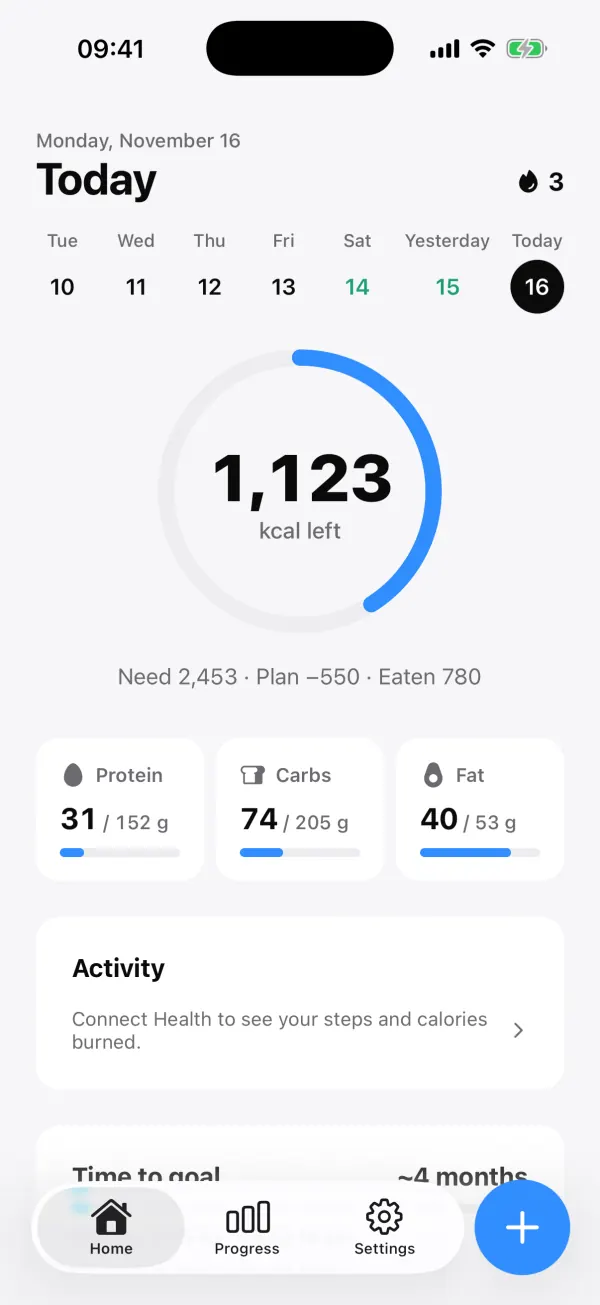
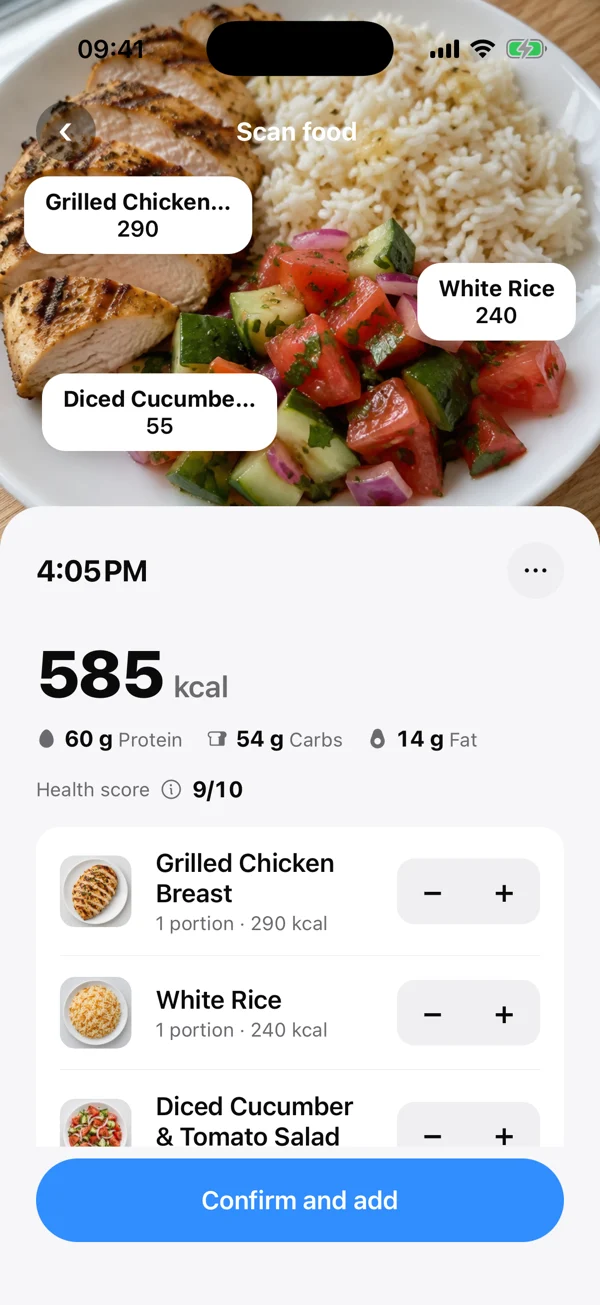
Snap a photo of your plate and get calories and macros in your log in seconds.