

































Crash diets and very-low-calorie diets: the risks

This article is general information, not medical advice. Talk to your doctor or a registered dietitian before changing your diet, especially if you have a health condition, take medication, or are pregnant or breastfeeding. Disclosure: Kalomo AI makes a calorie-tracking app, which we mention at the end of this article.
The short answer
A very-low-calorie diet (VLCD) means eating under 800 calories a day, usually as meal-replacement shakes and soups. UK guidance treats it as a short, supervised medical tool of no more than 12 weeks, not a do-it-yourself plan. Crash dieting without that support raises the risk of gallstones, side effects and weight regain, while a moderate deficit is the safer default for most people.
What counts as a crash diet or a very-low-calorie diet?
“Crash diet” is not a medical term. People use it for any plan that slashes food intake hard and fast to lose weight quickly: a week of juice, a 600-calorie “reset,” or eating almost nothing before an event.
A very-low-calorie diet has a precise definition. The UK's national guideline body, NICE, defines very-low-energy diets as under 800 kcal a day and low-energy diets as 800–1,200 kcal a day (NICE NG246). NHS 111 Wales uses the same 800-calorie line (NHS 111 Wales).
The difference between the two ideas matters. A clinical VLCD is nutritionally complete, time-limited and supervised. A crash diet you design yourself is usually none of those things.
How clinical VLCDs work
In research and in specialist clinics, very-low-energy diets are typically total meal replacement: every meal is a formulated shake, soup or bar that supplies protein, vitamins and minerals within a very small calorie budget. NICE notes that the studies it reviewed used total meal replacement for very-low-energy diets, and that most programs lasted 8–16 weeks, most often 12 (NICE NG246).
After that phase, normal foods are brought back step by step, and the person moves to long-term support for weight maintenance. The strict phase is deliberately short; the longer work of keeping the weight off comes afterward.
When doctors actually use them
NICE says very-low-energy diets should be considered only within a specialist weight management service, for people living with obesity who have a clinically assessed need to lose weight rapidly, for example to make surgery safer. It also says neither low-energy nor very-low-energy diets should be used as a long-term strategy (NICE NG246).
The best-known example is type 2 diabetes. In the DiRECT trial in UK primary care, participants followed a total diet replacement of 825–853 kcal a day for 3–5 months, then reintroduced food with ongoing support. At 12 months, 46% of the intervention group were in diabetes remission versus 4% of the control group, with an average weight loss of 10.0 kg versus 1.0 kg (Lean et al., The Lancet, 2018). That program was run by trained practice staff, with medication reviewed along the way.
The risks of going very low on your own
Very-low-calorie eating is not automatically dangerous, but the risks are real enough that guidelines insist on supervision. The main ones:
- Gallstones. The NIH's digestive disease institute says losing weight very quickly may raise your chances of forming gallstones and can stop the gallbladder from emptying properly. It advises talking with a doctor before starting a very-low-calorie diet (NIDDK).
- Common side effects. NICE lists constipation, fatigue and hair loss as risks of very-low-energy diets that should be explained before starting (NICE NG246).
- Medication problems. Doses of some medicines may need changing during rapid weight loss, so NICE asks clinicians to review all medicines first. This matters especially for diabetes and blood-pressure drugs.
- Weight cycling and regain. NICE tells clinicians to warn people that regain is likely and to plan maintenance support.
- Nutrient gaps. A homemade crash diet of a few foods is unlikely to be nutritionally complete, which is one of NICE's explicit conditions for these diets.
Who should not try a VLCD
NHS 111 Wales says VLCDs are not suitable or safe for everyone, are not routinely recommended for managing obesity, and should only be used under the supervision of a qualified health professional (NHS 111 Wales). In practice, don't try one on your own, and talk to a doctor first, if any of these apply:
- You are pregnant or breastfeeding.
- You are under 18.
- You have, or have had, an eating disorder. NICE asks clinicians to offer assessment and counseling for eating disorders before starting a restrictive diet.
- You take medicine for diabetes (especially insulin or drugs that can cause low blood sugar) or for blood pressure.
- You have had gallstones, or have kidney, heart or liver disease.
Calories and macros: why “less” is not always better
Weight loss comes from an energy deficit, but the size of the deficit is a choice with trade-offs. NHS 111 Wales says most people are advised to cut about 600 calories a day to lose weight at a safe and sustainable rate of 0.5–1 kg a week. For most men that means no more than 1,900 calories a day, and for most women no more than 1,400 (NHS 111 Wales). The NIDDK similarly suggests starting with a goal of 5–10% of your starting weight over 6 months (NIDDK).
With very few calories, every gram counts. That is why clinical formulas are built to cover protein and micronutrients first. If your plate is mostly fruit juice, crackers or “diet” snacks, the deficit may be large but the diet is poor. To find your own starting point and a moderate deficit, see the calorie guide.
What the evidence says
Short-term results are real. NICE's 2025 review found both low-energy and very-low-energy diets effective, with results lasting 3–5 years *when ongoing support was given* (NICE NG246). DiRECT showed meaningful health benefits for people with type 2 diabetes.
Losing weight fast doesn't automatically doom you to regain, but it doesn't protect you from it either. A randomized trial in Australia compared a 12-week rapid program with a 36-week gradual one. More people in the rapid group reached the weight-loss target, but over the following 144 weeks both groups regained about the same share, roughly three quarters, of what they lost (Purcell et al., Lancet Diabetes & Endocrinology, 2014). Speed didn't cause the regain, and it didn't prevent it.
What's missing is good evidence for unsupervised crash diets. Juice cleanses, “starvation” challenges and extreme fasting trends have not been tested the way supervised programs have. NICE also notes that evidence on eating disorders and the psychological impact of yo-yo dieting is limited, and it calls for more research.
Pros and cons at a glance
- Pro: rapid early weight loss that can help a specific medical goal, such as surgery or diabetes remission.
- Pro: a simple, fixed structure when done with formula products and clinical support.
- Con: gallstones, constipation, fatigue and hair loss are recognized risks.
- Con: medication may need adjusting, so it needs a clinician.
- Con: regain is likely without a long-term plan, and the strict phase cannot last beyond about 12 weeks.
- Con: unsupervised crash diets carry these risks without the safety net and with weaker evidence.
A safer way to lose weight faster than “slow”
If you want results you can see without a crash diet, a moderate, steady deficit is the evidence-backed middle ground: build meals around vegetables, lean protein and whole grains, keep portions honest, and track roughly for a few weeks to see where your calories really go. If your doctor thinks rapid weight loss would help a health condition, ask about a supervised low-energy or very-low-energy program, not a plan from social media.
Frequently asked questions
Is 800 calories a day safe?
Under 800 calories a day is the definition of a very-low-calorie diet. UK guidance says it should be nutritionally complete, last no more than 12 weeks and be supervised by a health professional. It is not a do-it-yourself plan (NICE NG246).
Do crash diets cause gallstones?
Losing weight very quickly may raise the chance of gallstones, partly because the gallbladder may not empty properly. The NIDDK advises talking with a doctor before starting a very-low-calorie diet, especially if you have had gallstones (NIDDK).
Will I gain the weight back after a crash diet?
Regain is common after any diet. In one trial, people who lost weight rapidly and people who lost it gradually regained a similar share over about three years (Purcell et al., 2014). Long-term support and a sustainable eating pattern matter more than the speed of the first phase.
How fast is it safe to lose weight?
NHS guidance describes 0.5–1 kg a week as a safe and sustainable rate for most people, usually from cutting about 600 calories a day (NHS 111 Wales).
Can very-low-calorie diets reverse type 2 diabetes?
In the DiRECT trial, almost half of participants on a supervised 825–853 kcal/day formula diet followed by food reintroduction were in remission at 12 months (Lean et al., 2018). This was a medically supported program with medication reviews. Don't attempt it alone if you take diabetes medicine.
Sources
- Overweight and obesity management (NG246): Physical activity and diet — National Institute for Health and Care Excellence (NICE)
- Obesity — NHS 111 Wales
- Dieting & Gallstones — National Institute of Diabetes and Digestive and Kidney Diseases (NIDDK)
- Primary care-led weight management for remission of type 2 diabetes (DiRECT): an open-label, cluster-randomised trial — The Lancet (via PubMed, NCBI)
- The effect of rate of weight loss on long-term weight management: a randomised controlled trial — The Lancet Diabetes & Endocrinology (via PubMed, NCBI)
Related articles
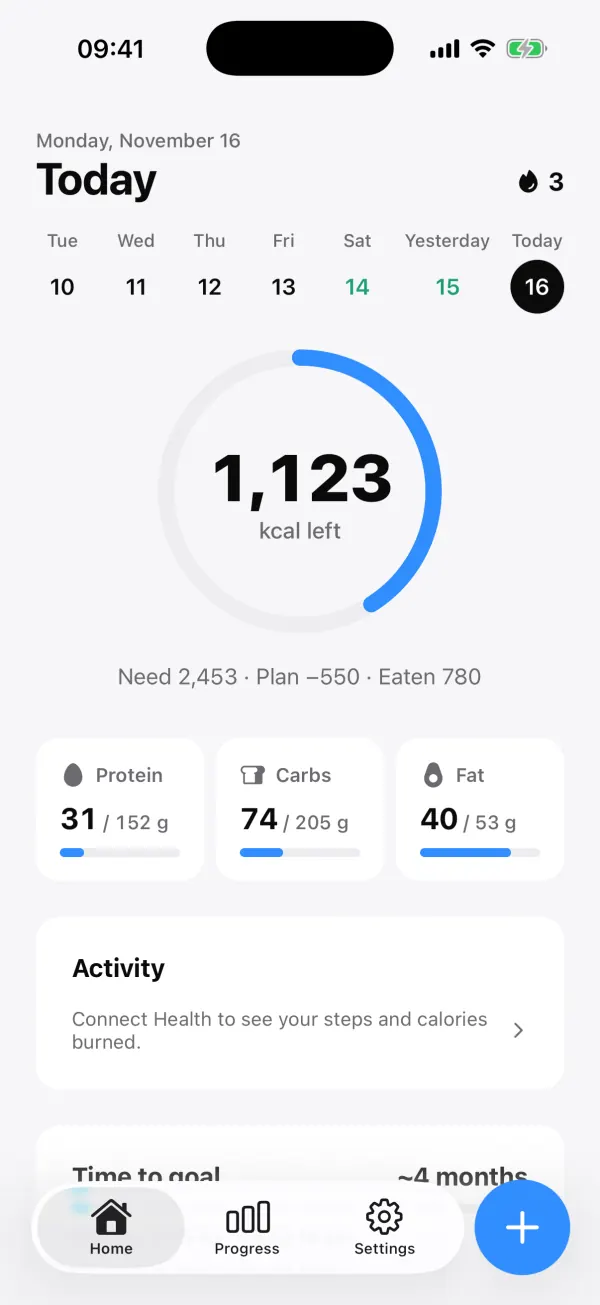
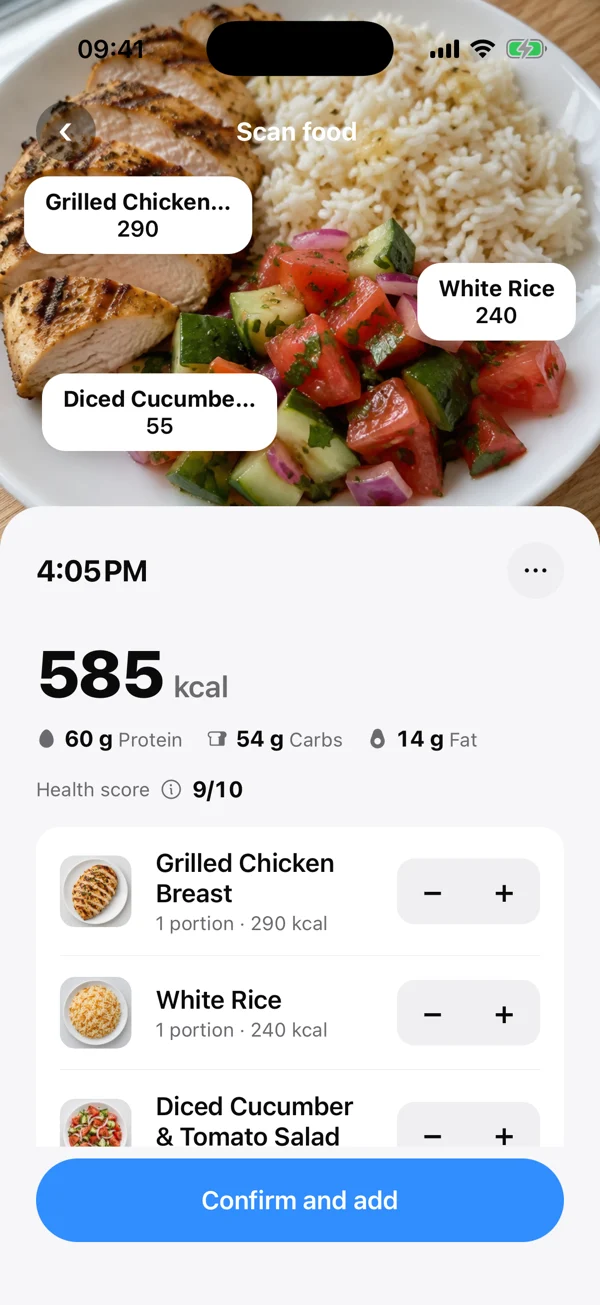
Track your plan with Kalomo AI
Snap a photo of your plate and get calories and macros in your log in seconds.