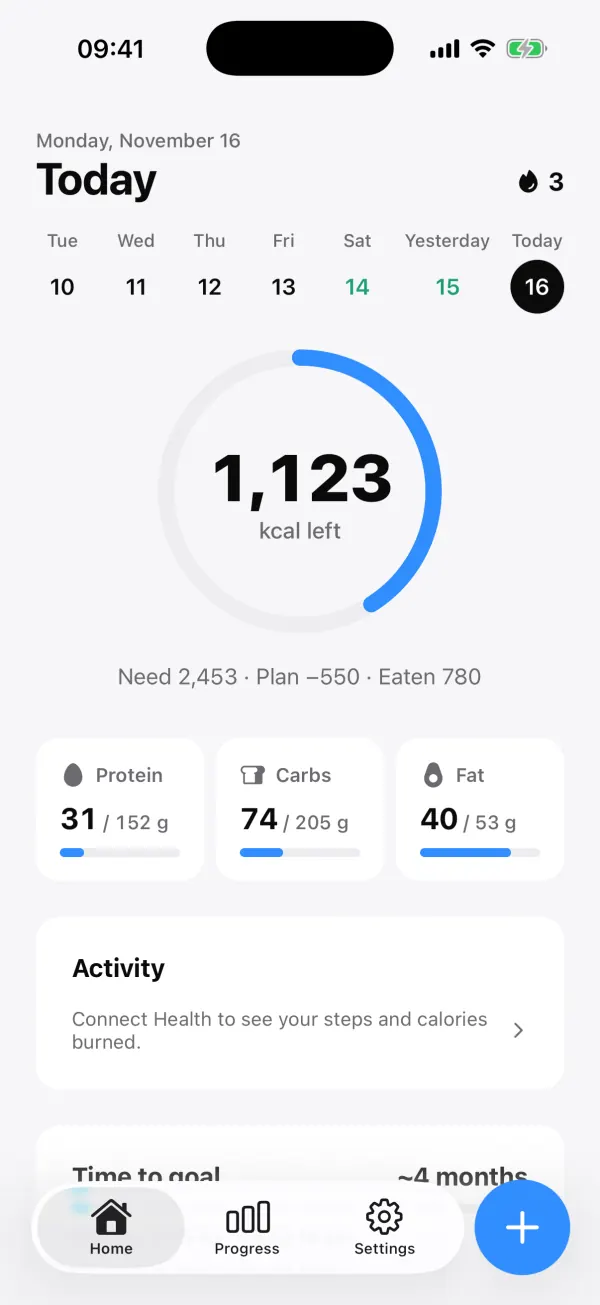


































What is a calorie deficit and how do you create one?

This article is general information, not medical advice. Talk to your doctor or a registered dietitian before changing your diet, especially if you have a health condition, take medication, or are pregnant or breastfeeding. Disclosure: Kalomo AI makes a calorie-tracking app, which we mention at the end of this article.
The short answer
A calorie deficit means taking in less energy from food and drinks than your body uses in a day, and it's the basic condition for losing weight. You create one by estimating what you burn, then trimming portions, drinks and snacks a little below that. The NHS suggests aiming for a slow, steady 0.5–1 kg (1–2 pounds) a week.
What a calorie deficit is and how it works
Your body spends energy all day long: keeping your heart beating and your lungs working, digesting food, and moving you around. Food and drinks supply that energy. When the two roughly match, your weight holds steady. When you take in less than you use, your body makes up the gap from its stores, mostly body fat. As the NHS puts it, you're likely to lose weight if you eat and drink fewer calories than you use.
As a rough benchmark, the NHS says an average woman uses about 2,000 calories a day and an average man about 2,500, but those numbers shift a lot with age, height, weight and how active you are (NHS). Your deficit doesn't have to look like anyone else's.
Estimating what you burn
You need a starting point before you can subtract from it. One of the most widely used formulas is the Mifflin-St Jeor equation, published in 1990 after researchers measured the resting energy use of 498 healthy adults aged 19 to 78 (Mifflin et al., 1990). It works in metric units:
- Men: 10 × weight (kg) + 6.25 × height (cm) − 5 × age + 5
- Women: 10 × weight (kg) + 6.25 × height (cm) − 5 × age − 161
- Example: a 35-year-old woman who is 165 cm (5 ft 5 in) tall and weighs 70 kg (154 lb) gets 700 + 1,031 − 175 − 161 ≈ 1,395 calories
What that number does and doesn't tell you
Mifflin-St Jeor estimates your energy use at rest. Walking, working and exercise come on top. If you'd rather have a tool that handles activity for you, the NIH's Body Weight Planner from NIDDK asks for your weight, height, age, activity level and goal date, then estimates the calories to reach your goal and to maintain it afterward. It's built for adults 18 and older and isn't medical advice.
Every one of these numbers is an estimate. Watching your weight trend over a few weeks and adjusting is more reliable than trusting any single calculation.
How to build a deficit you can live with
Small changes you can repeat every day tend to outlast big, sudden cuts. The NHS recommends aiming to lose 1–2 pounds a week (NHS). Practical places to start:
- Track what you eat for a few days. Sweet drinks, coffee add-ins and late-night snacks often turn out to be the easiest wins.
- Swap fried for grilled, baked or roasted, and measure cooking oil instead of pouring it.
- Fill half your plate with vegetables. The WHO recommends at least 400 g of fruit and vegetables a day for everyone over 10 (WHO).
- Shrink portions of bread, pasta and rice rather than banning them.
- Trade soda, sweet tea and lemonade for water, sparkling water or unsweetened drinks.
- Look up the foods you eat most in our calorie guide. A bowl of chicken noodle soup and a chicken pot pie are both comfort food, but the gap between them is hard to miss.
How a deficit relates to macros
Total energy balance is what drives weight loss, but what you cut still matters, because you need to keep getting the nutrients your body relies on while eating less. The WHO's healthy-diet guidance is a sensible guide: keep total fat at or below 30% of daily energy, free sugars under 10%, salt under 5 g a day, and eat plenty of fruit and vegetables (WHO).
In practice, a balanced deficit usually keeps filling foods such as vegetables, beans, eggs, yogurt, fish and chicken, and trims added sugar and extra fat, rather than relying on skipped meals or cutting out a whole food group.
Pros and cons
Pros: A calorie deficit is a principle, not a branded diet. It works alongside Mediterranean eating, a low-carb plan, intermittent fasting or plain home cooking. Nothing is off-limits, and it can be tuned to you. Modest results count, too: the NHLBI notes that losing 3–5% of your weight can help lower blood triglycerides and glucose, and that health professionals recommend losing 5–10% over about six months (NHLBI).
Cons: Your body burns less as you get lighter. An NIH-led model found that body weight responds to a change in intake slowly, with a half-time of about a year, and that people with more body fat lose more for the same change (Hall et al., 2011). That's why the pace of the first few weeks rarely lasts. Counting calories can also feel tedious; for some people, simpler approaches like portion control fit better.
Who should check with a professional first
A moderate deficit is a reasonable approach for most adults, but it isn't one-size-fits-all. Talk with your doctor or a registered dietitian before cutting calories if any of these apply:
- You're pregnant or breastfeeding
- You're a child or a growing teen (tools like the Body Weight Planner are designed for adults only)
- You have a history of an eating disorder
- You take medication for diabetes, blood pressure or another condition
- You're considering a very-low-calorie diet: the NHS says diets under 800 or 1,200 calories are not suitable or safe for everyone, are usually recommended only when weight affects other health conditions, and are followed with a dietitian's support (NHS)
What the evidence says
That energy balance drives body weight is one of the best-established findings in nutrition, and it underpins guidance from the NHS and the WHO alike. The open question is how best to create the deficit. Low-carb, low-fat and fasting-style plans can all work, and what tends to matter most is whether a person can stick with the approach over time. Picking a pattern that fits your tastes, budget and schedule is part of the strategy.
A sample day
A filling day built from dishes on our site, suited to a moderate deficit. These five items come to roughly 1,080 calories; add fruit, vegetables, milk or bread to reach your own target.
- BreakfastOatmeal1 bowl is about 154 calories; top with berries.154 kcal1 bowl
- LunchChili1 bowl is about 295 calories with 24 g of protein.295 kcal1 bowl
- DinnerGrilled chicken breast1 breast is about 299 calories and 50 g of protein.299 kcal1 breast
- Dinner sideBaked potato1 potato is about 250 calories; go easy on the toppings.250 kcal1 potato
- Dinner sideGreen bean casserole1 serving is about 84 calories.84 kcal1 serving
Frequently asked questions
How big should my calorie deficit be?
There's no single right number, because your needs depend on age, height, weight and activity. The NHS suggests a pace of 1–2 pounds a week. You can estimate your own target with the NIH's Body Weight Planner, then adjust based on how your weight trends over a few weeks.
Why am I not losing weight in a calorie deficit?
Most often, intake is a bit higher or burn a bit lower than estimated; the formulas are approximations. Your body also burns less as you lose weight, and weight settles into a new balance slowly (Hall et al., 2011). Judge progress by the trend over several weeks, not day-to-day swings on the scale.
Can I lose weight with a deficit and no exercise?
Yes, a deficit can come from eating less alone. Still, the NHS recommends doing more physical activity to burn more calories when you're trying to lose weight, and activity helps your health in other ways too (NHS).
Is eating very few calories a faster way to lose weight?
The NHS says very-low-calorie diets aren't suitable or safe for everyone and are usually reserved for people whose weight is affecting their health and who need to lose weight quickly, with a dietitian's support. A moderate deficit is the safer place to start on your own.
Sources
- Understanding calories — NHS
- Overweight and obesity in adults — NHS
- A new predictive equation for resting energy expenditure in healthy individuals (Am J Clin Nutr, 1990) — Mifflin MD, St Jeor ST, et al. — PubMed
- Body Weight Planner — NIDDK, National Institutes of Health
- Quantification of the effect of energy imbalance on bodyweight (Lancet, 2011) — Hall KD, et al. — PubMed
- Healthy diet — World Health Organization
- Aim for a Healthy Weight — NHLBI, National Institutes of Health
Related articles
Track your plan with Kalomo AI
Snap a photo of your plate and get calories and macros in your log in seconds.