




















What is the DASH diet?
This article is general information, not medical advice. Talk to your doctor or a registered dietitian before changing your diet, especially if you have a health condition, take medication, or are pregnant or breastfeeding. Disclosure: Kalomo AI makes a calorie-tracking app, which we mention at the end of this article.
The short answer
DASH (Dietary Approaches to Stop Hypertension) is an eating plan developed from research funded by the National Heart, Lung, and Blood Institute to prevent and lower high blood pressure. It is built on vegetables, fruit, whole grains, low-fat dairy, fish, poultry, beans and nuts, and it limits sodium, saturated fat and sweets. It is not a weight-loss diet first, but it scales to any calorie level, so it can be part of a weight-loss plan.
What the DASH diet is and how it works
Despite the name, DASH is less a diet than a long-term way of eating. It doesn't require special foods; it sets daily and weekly targets for food groups. According to the NHLBI, the plan emphasizes vegetables, fruits and whole grains; fat-free or low-fat dairy; and fish, poultry, beans, nuts and vegetable oils. It limits foods high in saturated fat, such as fatty meats, full-fat dairy and tropical oils like coconut and palm kernel, along with sugar-sweetened drinks and sweets NHLBI.
The idea is to change your intake of the nutrients that affect blood pressure. The NHLBI recommends foods rich in potassium, calcium, magnesium, fiber and protein, and caps sodium at 2,300 mg a day, noting that 1,500 mg lowers blood pressure even further NHLBI.
For context, the World Health Organization advises adults to keep sodium under 2,000 mg a day, which is less than 5 g of salt, or just under a teaspoon. WHO reports that average adult intake is more than double that, and that excess sodium raises blood pressure and with it the risk of cardiovascular disease WHO.
How to follow DASH: daily servings
For someone eating about 2,000 calories a day, the NHLBI lists these targets NHLBI:
- Grains: 6–8 servings a day, mostly whole grains
- Vegetables: 4–5 servings a day
- Fruit: 4–5 servings a day
- Fat-free or low-fat dairy: 2–3 servings a day
- Meat, poultry and fish: 6 servings or fewer a day, lean choices
- Fats and oils: 2–3 servings a day
- Nuts, seeds, dry beans and peas: 4–5 servings a week
- Sweets: 5 servings or fewer a week
- Sodium: no more than 2,300 mg a day (1,500 mg for a bigger effect)
Getting started: practical steps
The NHLBI's first step is to estimate your calorie needs from your age and activity level, then use the serving table closest to that number; tables run from 1,200 to 3,100 calories a day NHLBI. Our calorie guide can help you get a starting estimate.
From there, a few habits do most of the work:
- Make most grain servings whole grain: oatmeal, whole-wheat bread, brown rice.
- Choose lean cuts, trim visible fat, remove poultry skin, and broil, roast or poach instead of frying NHLBI.
- Read the Nutrition Facts label. Processed foods such as bread, deli meats, snacks and sauces are often high in sodium WHO.
- Taste before you salt, and lean on lemon, vinegar, garlic, herbs and spices for flavor.
- If dairy bothers you, try lactose-free milk or lactase pills NHLBI.
- Pair the plan with regular physical activity, which the NHLBI recommends alongside it.
- Add one change a week, such as an extra vegetable at lunch, rather than overhauling everything at once.
How DASH relates to calories and macros
DASH doesn't set a calorie target of its own; serving counts scale with your energy needs, from 1,200 calories a day upward NHLBI. If weight loss is a goal, choosing a calorie level a bit below what you burn turns DASH into a calorie-deficit plan built on nutritious food.
On macros, DASH is not low-carb. It leans on grains, fruit and vegetables, keeps saturated fat down and gets protein from lean sources. In the OmniHeart trial described by the NHLBI, swapping 10% of daily calories from carbohydrate to either protein or unsaturated fat improved blood pressure and blood lipids a little more than the original DASH plan NHLBI. So you can adjust the balance and keep the core pattern.
Pros and cons
Pros: DASH is backed by randomized trials, bans no food group, needs no special products and works for a whole household. The NHLBI notes that it also lowers LDL cholesterol and reduces the risk of type 2 diabetes and heart disease NHLBI.
Cons: Counting servings takes effort at first. Getting sodium below 2,300 mg, let alone 1,500 mg, is hard when you eat out or rely on packaged food. DASH doesn't promise fast weight loss; you still need to manage total calories if that's your goal. And because it's a pattern rather than a set menu, it asks you to plan meals yourself.
Who should check with a doctor first
DASH is a balanced pattern, but talk to your doctor or a registered dietitian before starting if any of these apply:
- Chronic kidney disease: DASH relies on potassium-rich foods. The NIDDK advises people with CKD to work with a dietitian or health care professional to find the right amount of potassium and protein for them NIDDK.
- Taking blood-pressure medication: diet changes can lower blood pressure, so don't stop or adjust medication on your own; track your readings with your doctor.
- Pregnancy or breastfeeding: needs are different; ask your clinician about sodium and portions.
- Children and teens: the adult serving tables shouldn't be applied directly.
- A history of eating disorders: tracking servings can be unhelpful; get professional support.
What the evidence says
DASH is one of the most studied eating patterns. In the original DASH trial, 459 adults followed DASH or comparison diets for eight weeks, and DASH lowered blood pressure more than the others NHLBI.
The DASH-Sodium trial (412 participants) tested DASH at three sodium levels. Both DASH and lower sodium reduced blood pressure, and the combination worked best. Compared with a typical American diet at high sodium, low-sodium DASH produced systolic blood pressure that was on average 7.1 mm Hg lower in people without hypertension and 11.5 mm Hg lower in people with hypertension Sacks et al., NEJM 2001.
A 2020 meta-analysis of 30 randomized trials with 5,545 participants found DASH lowered systolic blood pressure by 3.2 mm Hg and diastolic by 2.5 mm Hg compared with control diets, in people with and without hypertension. The authors rated the quality of evidence as moderate Filippou et al., Adv Nutr 2020.
The weight-loss evidence is more indirect. In the PREMIER trial described by the NHLBI, people who combined DASH with counseling and more physical activity achieved both weight loss and lower blood pressure NHLBI. DASH is a strong choice for heart health; weight loss depends on calories and lifestyle, not on DASH alone.
A sample day
A DASH-style day built from dishes on our site. Values use the site's standard portions; these four dishes add up to roughly 1,500 calories. Fill in with fruit, vegetables and low-fat dairy to match your needs, and go light on added salt.
- BreakfastOatmealOne bowl is about 154 calories; top with berries and a splash of low-fat milk.154 kcal1 bowl
- LunchBurrito bowlAbout 652 calories for a big bowl with chicken, beans and rice; pile on extra vegetables and go easy on the cheese.653 kcal1 bowl
- DinnerBaked salmonOne fillet is about 466 calories; fish is one of the lean protein choices DASH favors.466 kcal1 fillet
- Dinner sideBaked potatoAbout 250 calories with the skin; eat the peel and skip extra salt.250 kcal1 potato
Frequently asked questions
Can you lose weight on the DASH diet?
DASH is designed to lower blood pressure, but you can lose weight on it if you pick a calorie level below your needs; the NHLBI offers serving plans starting at 1,200 calories. In the PREMIER trial, DASH plus counseling and more activity led to both weight loss and lower blood pressure NHLBI.
How much sodium is allowed on DASH?
The standard plan caps sodium at 2,300 mg a day, and a lower-sodium version at 1,500 mg NHLBI. WHO advises adults to stay under 2,000 mg WHO. In many countries a large share comes from processed foods such as bread, processed meat and snacks, not just the salt shaker WHO.
Is DASH the same as the Mediterranean diet?
They overlap a lot: both center on vegetables, fruit, whole grains and beans. DASH is more structured, with serving targets and a firm sodium limit, and it specifically recommends low-fat dairy. The Mediterranean pattern is built around olive oil and a broader lifestyle, with fewer numeric targets.
If I start DASH, can I stop my blood-pressure medication?
Not on your own. DASH can lower blood pressure Sacks et al., NEJM 2001, but only your doctor can decide whether to change your dose, based on your readings.
How fast does DASH work?
In the trials, blood-pressure changes were measured over weeks: eight weeks in the original DASH study and one month per sodium level in DASH-Sodium NHLBI. To follow your own progress, check your readings regularly and share them with your doctor.
Sources
- DASH Eating Plan — National Heart, Lung, and Blood Institute (NHLBI), NIH
- Following DASH — National Heart, Lung, and Blood Institute (NHLBI), NIH
- Health Benefits of DASH — National Heart, Lung, and Blood Institute (NHLBI), NIH
- Effects on blood pressure of reduced dietary sodium and the Dietary Approaches to Stop Hypertension (DASH) diet (N Engl J Med, 2001) — PubMed / NCBI
- Dietary Approaches to Stop Hypertension (DASH) Diet and Blood Pressure Reduction in Adults with and without Hypertension: A Systematic Review and Meta-Analysis of Randomized Controlled Trials (Adv Nutr, 2020) — PubMed / NCBI
- Sodium reduction — World Health Organization (WHO)
- Healthy Eating for Adults with Chronic Kidney Disease — National Institute of Diabetes and Digestive and Kidney Diseases (NIDDK)
Related articles
Track your plan with Kalomo AI
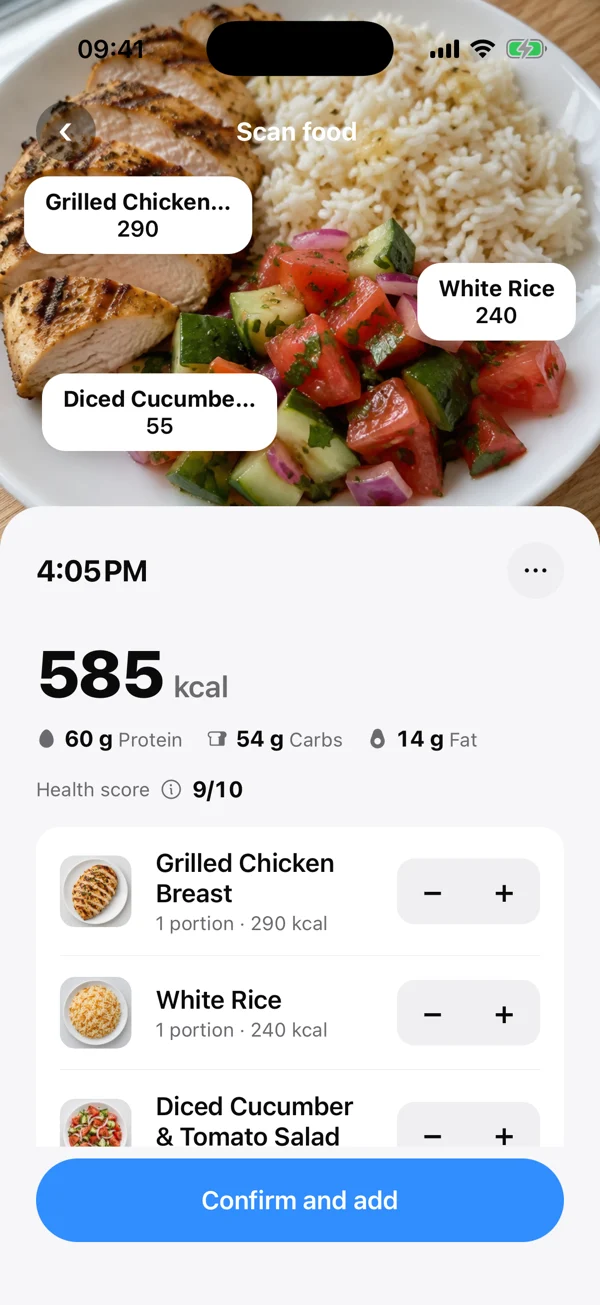
Snap a photo of your plate and get calories and macros in your log in seconds.