

































The Atkins diet: phases and how it works
This article is general information, not medical advice. Talk to your doctor or a registered dietitian before changing your diet, especially if you have a health condition, take medication, or are pregnant or breastfeeding. Disclosure: Kalomo AI makes a calorie-tracking app, which we mention at the end of this article.
The short answer
The Atkins diet, created by cardiologist Robert Atkins, is a low-carb plan that starts with very few carbs and adds them back step by step. The classic version has four phases: 20 g of net carbs a day to start, then up to 30 g, then increases of up to 10 g a week until you reach your goal weight, and finally maintenance at up to 120 g a day. Some trials show faster weight loss in the first months, but at a year and beyond it hasn't clearly beaten other diets.
What is the Atkins diet?
Atkins is a low-carbohydrate eating plan, named for the cardiologist Robert Atkins, that leans on protein and fat Cleveland Clinic. Instead of counting calories, you count carbs, specifically net carbs: the total carbohydrate in a food minus its fiber Cleveland Clinic.
To get a feel for how strict that is: Cleveland Clinic notes that an average banana has about 24 g of net carbs and a potato about 31 g. A single banana would use up more than a whole day's allowance in the first phase Cleveland Clinic.
The four phases of Atkins
The classic Atkins plan moves through four phases. Cleveland Clinic summarizes them by their daily net-carb limits Cleveland Clinic:
- Phase 1: 20 g of net carbs a day. The most restrictive phase, aimed at quick weight loss; meals center on protein and fat.
- Phase 2: up to 30 g of net carbs a day. Weight loss continues, more slowly.
- Phase 3: add up to 10 g of net carbs per week until you reach your goal weight.
- Phase 4 (maintenance): up to 120 g of net carbs a day while you stay at your goal weight.
Atkins 20, 40 and 100
Because the classic plan starts at 20 g, it's often called Atkins 20. Cleveland Clinic notes there are other Atkins plans that allow 40 g or 100 g of net carbs from the start, designed for people with less weight to lose or who want to maintain Cleveland Clinic. In research terms, the 100 g plan falls within the low-carb range (more than 50 g up to 150 g a day), while the 20 g start is very low-carb (50 g or less) Naude et al., Cochrane 2022.
How to follow Atkins more safely
A few choices make a big difference to how healthy your version of Atkins is:
- Track net carbs. Subtract fiber from total carbs on the label; for home-style dishes, check our calorie guide.
- Don't build it on processed meat. Atkins allows bacon, sausage and deli meats, but processed meats may raise the risk of heart problems and certain cancers Cleveland Clinic. Put fish, poultry, eggs and yogurt first.
- Favor plant fats. Olive and canola oil, nuts and fish; go easy on butter and red meat Harvard T.H. Chan.
- Keep the vegetables. Leafy greens, zucchini, cucumber, peppers and cauliflower are low in net carbs and can fill most of your plate even at 20 g.
- Read labels on Atkins-branded products. Bars, shakes and frozen meals can contain artificial sweeteners, processed ingredients, saturated fat and sodium Cleveland Clinic.
- Bring healthy carbs back for the long term. Fresh fruit and whole grains belong in maintenance Cleveland Clinic.
How Atkins relates to calories and macros
Atkins doesn't ask you to count calories, but energy balance still drives weight loss. According to Cleveland Clinic, cutting carbs tends to remove foods like white bread, fried foods and sugar, which lowers total calories, and protein and fat help curb hunger Cleveland Clinic.
In the early phases, carbs supply only a small share of your energy; protein and fat make up the rest. Since fat has more calories per gram, treating low-carb as a license to eat unlimited amounts can stall progress. Portions still count.
Pros and cons
Pros: The rules are clear and food choices are simple. Protein and fat are filling. Eating very few carbs may help with blood sugar control, especially in people with diabetes Cleveland Clinic. In one trial, HDL (good) cholesterol rose and triglycerides fell more on the low-carb diet than on a conventional diet Foster et al., NEJM 2003.
Cons: Restricting fruit and some vegetables can lead to nutrient gaps. Reported side effects include electrolyte imbalances, constipation, dangerously low blood sugar and kidney problems. There's no evidence yet of long-term health benefits; most studies ran for less than a year or two Cleveland Clinic. And in trials, adherence tended to be poor and dropout high Foster et al., NEJM 2003.
Who shouldn't do Atkins
Cleveland Clinic says people who are pregnant, breastfeeding or have kidney disease should not try Atkins, and that people with diabetes or other health conditions should talk to a doctor first Cleveland Clinic. Also check with your doctor before starting if any of these apply:
- You take diabetes medication or insulin: the 20 g phase can lower blood sugar quickly, and your dose may need adjusting.
- You take blood-pressure medication: weight and diet changes can change what you need, so don't adjust it on your own.
- You have high cholesterol or heart disease: a version heavy in saturated fat and processed meat may not suit your risk profile; monitor your labs with your doctor Cleveland Clinic.
- Children and teens: this level of restriction isn't appropriate during growth.
- A history of eating disorders: strict rules and forbidden-food lists are risky; get professional support.
What the evidence says
In a one-year randomized trial of 63 adults with obesity, the Atkins group lost more weight than a conventional low-fat group at 3 and 6 months, but the difference at 12 months wasn't statistically significant. Adherence was poor and dropout high in both groups Foster et al., NEJM 2003.
The A TO Z study randomized 311 premenopausal women. Average 12-month weight loss was 4.7 kg on Atkins, 1.6 kg on Zone, 2.6 kg on LEARN and 2.2 kg on Ornish; only the Atkins-versus-Zone difference was statistically significant Gardner et al., JAMA 2007.
A trial of 160 adults comparing Atkins, Zone, Weight Watchers and Ornish found that each diet modestly reduced weight at one year. Only about half of the Atkins group finished, and weight loss tracked with how well people stuck to their diet, not with which diet they followed Dansinger et al., JAMA 2005.
Larger studies point the same way. A Cochrane review of 61 randomized trials found that low-carb weight-loss diets probably make little to no difference in weight compared with balanced-carb diets for up to two years Naude et al., Cochrane 2022. And in long-term observational data, replacing carbs with animal fat and protein was associated with higher mortality, while replacing them with plant sources was associated with lower mortality Seidelmann et al., Lancet Public Health 2018. If you choose Atkins, building it around plant fats, nuts and fish looks like the safer bet.
A sample day
A day close to Atkins Phase 1, built from dishes on our site. At the site's standard portions these five dishes come to about 1,370 calories and 16 g of net carbs. Add low-carb vegetables or olive oil to meet your energy needs; bread, rice, potatoes and fruit are out in this phase.
- BreakfastScrambled eggsTwo eggs, about 218 calories and 1 g of carbs. Add spinach or mushrooms.218 kcal2 eggs
- LunchGrilled chicken breastOne breast, about 299 calories with no carbs.299 kcal1 breast
- Lunch sideCaesar saladAbout 278 calories and 11 g of net carbs, mostly from croutons; skip them to save carbs.278 kcal1 bowl
- DinnerBaked salmonOne fillet, about 466 calories with no carbs and plenty of unsaturated fat.466 kcal1 fillet
- Dinner sideCollard greensOne cup, about 109 calories and 4 g of net carbs; this recipe uses smoked ham, so watch the salt.109 kcal1 cup
Frequently asked questions
How long does Atkins Phase 1 last?
Phase 1 allows 20 g of net carbs a day. Cleveland Clinic doesn't give a fixed length; it depends on your goals Cleveland Clinic. Talk to your doctor before staying on a restriction this tight for long.
How do you calculate net carbs?
Subtract fiber from total carbohydrate. A food with 10 g of carbs and 4 g of fiber has 6 g of net carbs Cleveland Clinic.
What's the difference between Atkins and keto?
Both cut carbs hard. Keto keeps carbs very low throughout to stay in ketosis. Atkins starts at 20 g and adds carbs back phase by phase, allowing up to 120 g of net carbs a day in maintenance Cleveland Clinic.
Is the Atkins diet bad for your heart?
Short-term trials showed some favorable changes in blood lipids Foster et al., NEJM 2003, but long-term evidence is lacking. A version built on processed meat may raise the risk of heart problems Cleveland Clinic; one built on fish, olive oil and nuts is the safer choice.
Will the weight come back after Atkins?
It can if you go back to your old way of eating. In trials, sticking with a diet mattered more for weight loss than which diet it was Dansinger et al., JAMA 2005. That's why the maintenance phase is meant to be a lasting pattern, not an end point.
Sources
- What Is the Atkins Diet and Is It Healthy? — Cleveland Clinic
- A randomized trial of a low-carbohydrate diet for obesity (N Engl J Med, 2003) — PubMed / NCBI
- Comparison of the Atkins, Zone, Ornish, and LEARN diets for change in weight and related risk factors among overweight premenopausal women: the A TO Z Weight Loss Study (JAMA, 2007) — PubMed / NCBI
- Comparison of the Atkins, Ornish, Weight Watchers, and Zone diets for weight loss and heart disease risk reduction: a randomized trial (JAMA, 2005) — PubMed / NCBI
- Low-carbohydrate versus balanced-carbohydrate diets for reducing weight and cardiovascular risk (Cochrane Database Syst Rev, 2022) — PubMed / NCBI
- Dietary carbohydrate intake and mortality: a prospective cohort study and meta-analysis (Lancet Public Health, 2018) — PubMed / NCBI
- Low-Carbohydrate Diets — Harvard T.H. Chan School of Public Health, The Nutrition Source
Related articles
Track your plan with Kalomo AI
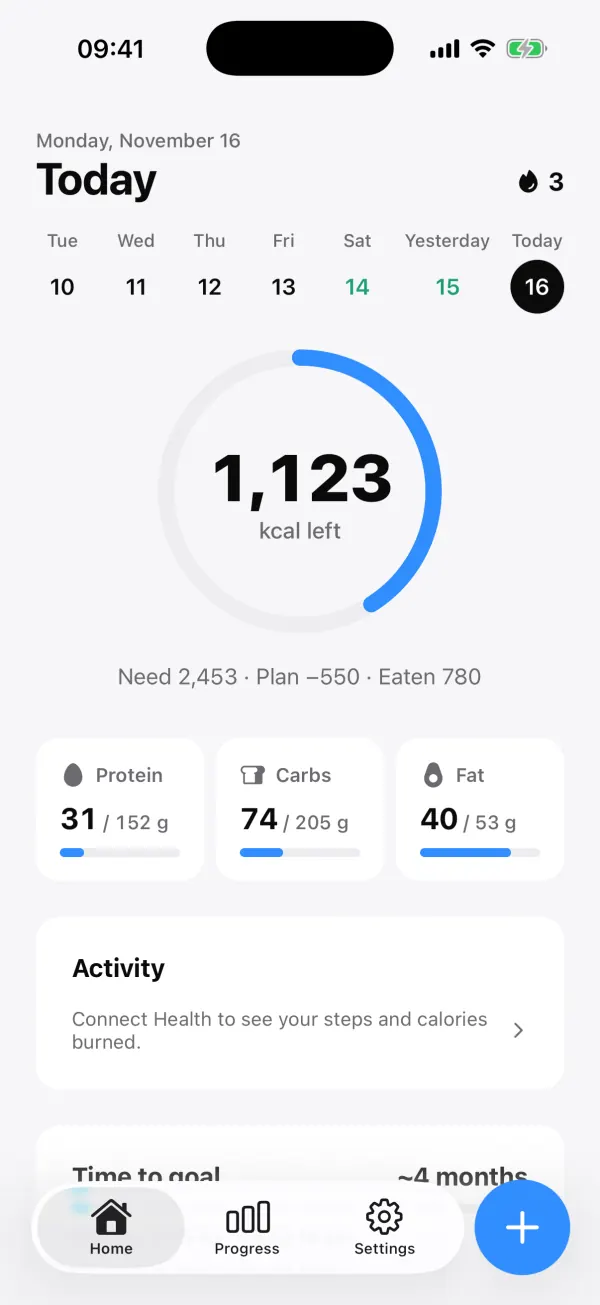
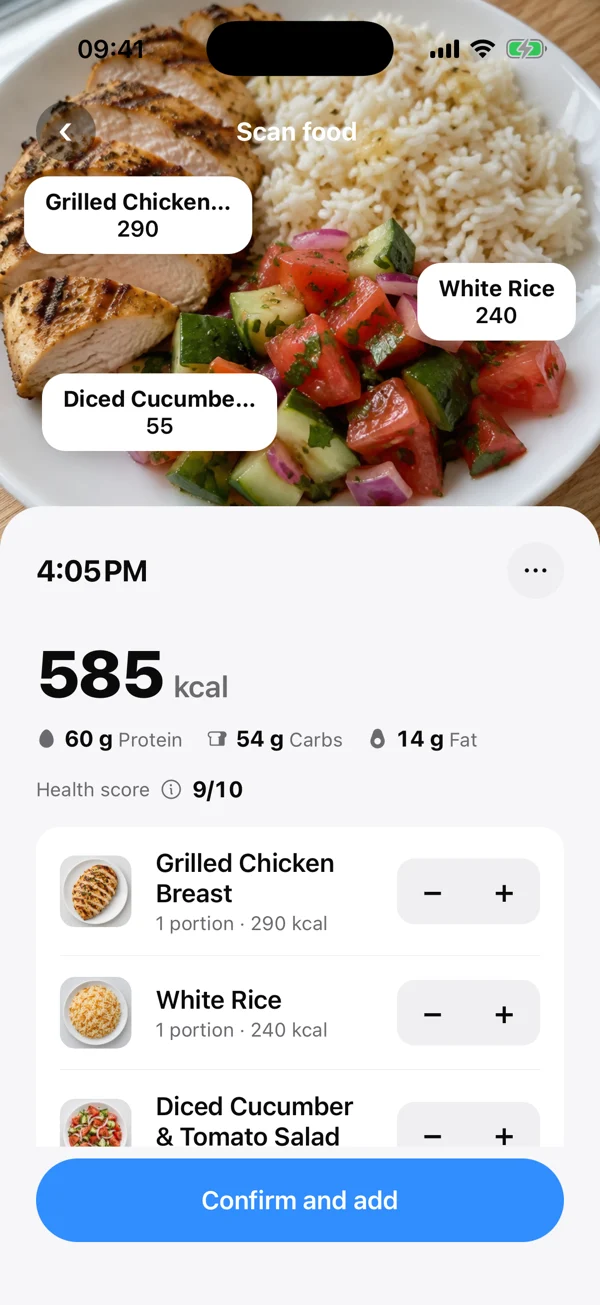
Snap a photo of your plate and get calories and macros in your log in seconds.